¶ Introduction
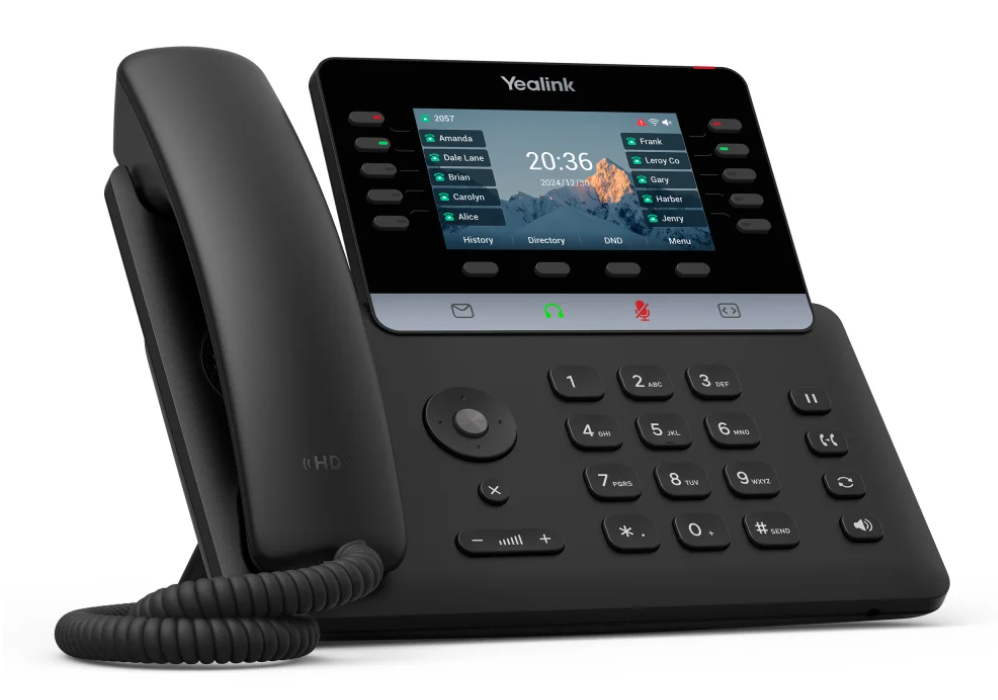
This Configuration Guide is written as general guide on how to configure the Yealink phone model T74 LTE to work with PBXware v7.6.3.
¶ Requirements
¶ Identifying the Phone Model
To ensure a successful registration, first confirm that you have the correct Yealink phone model.
The model information can be found on the back of your Yealink phone. This guide is designed for the Yealink T74 LTE. Other models may require different configuration steps, so verifying you have the T74 LTE ensures proper setup.
¶ Phone Firmware
- Make sure that your phone is loaded with appropriate firmware version, 190.86.254.145.
- To check the firmware version of your Yealink phone, open a browser window and enter the phone's IP address to access the web administration interface. Example:
http://192.168.1.22. - Log in using the username admin and the password that was previously set up on the phone.
- Click the Status tab in left navigation menu.
- The Firmware field will show the current firmware version.
¶ DHCP Server
Fully configured and operational DHCP server.
¶ PBXware Version
PBXware versions 7.6.3
To check the PBXware version:
- Log in to PBXware
- Navigate to Settings: About.
At the top of the About page, you will see a code block similar to this:
PBXware Edition: Multi-Tenant, Release: 7.6 (387597b7), Running: 18.15.0.-gc-b47edc45, PBXware Proxy v7.6 (62b7bcd), API: 7, libmemcached version: 1.0.18
The Release field indicates the exact version of your PBXware.
¶ Installation
This section describes how to connect the phone to power and the data network, as well as how to apply factory settings.
The following topics are covered:
- Power and Network Connection
- Factory Settings
¶ Power and Network Connection
- Connect the DC plug on the power adapter to the DC port on the phone and connect the other end to a power outlet.
- Connect the Ethernet cable between the Internet port on the phone and a network port on your router or switch.
¶ Find the Phone's IP Address
Find out your Yealink phone's IP Address.
- Go to Menu -> Status
The IP address will be displayed in IPv4 field.
¶ Reset to Factory Settings
This step is not required for brand new, out-of-the-box phones. However, if the phone has already been used, it is required.
- Open a browser window and enter the phone's IP address to access the web administration interface. Example:
http://192.168.1.22. - Log in using the username admin and the password that was previously set up on the phone.
- Navigate to the Settings section and select the Upgrade.
- Click the Reset to Factory Settings button to initiate the reset process. The phone will be reset to its default factory settings and automatically reboot.
- Wait for the device to complete the reset and reboot process.
- After reboot, all settings will return to defaults.
NOTE: Do not unplug or remove power from the device while the factory reset process is in progress.
¶ Registering the Phone
This section describes how to identify the Yealink phone model, requirements that must be met, and how to register the phone using manual configuration or auto-provisioning.
The following topics are covered:
- Manual Configuration
- Auto Provisioning
¶ Manual Configuration
This section describes how to set the UAD settings, create a PBXware Extension, and register the phone.
The following topics are covered:
- UAD Settings
- Creating an Extension
- Registering the Phone
¶ UAD Settings
1. Log in to PBXware's web administration interface
- Open a new browser window and enter the PBXware IP address to access the administration login screen. Example:
http://192.168.1.10 - Log in to PBXware with your e-mail address and password.
2. UAD settings
- Navigate to Settings > UAD.
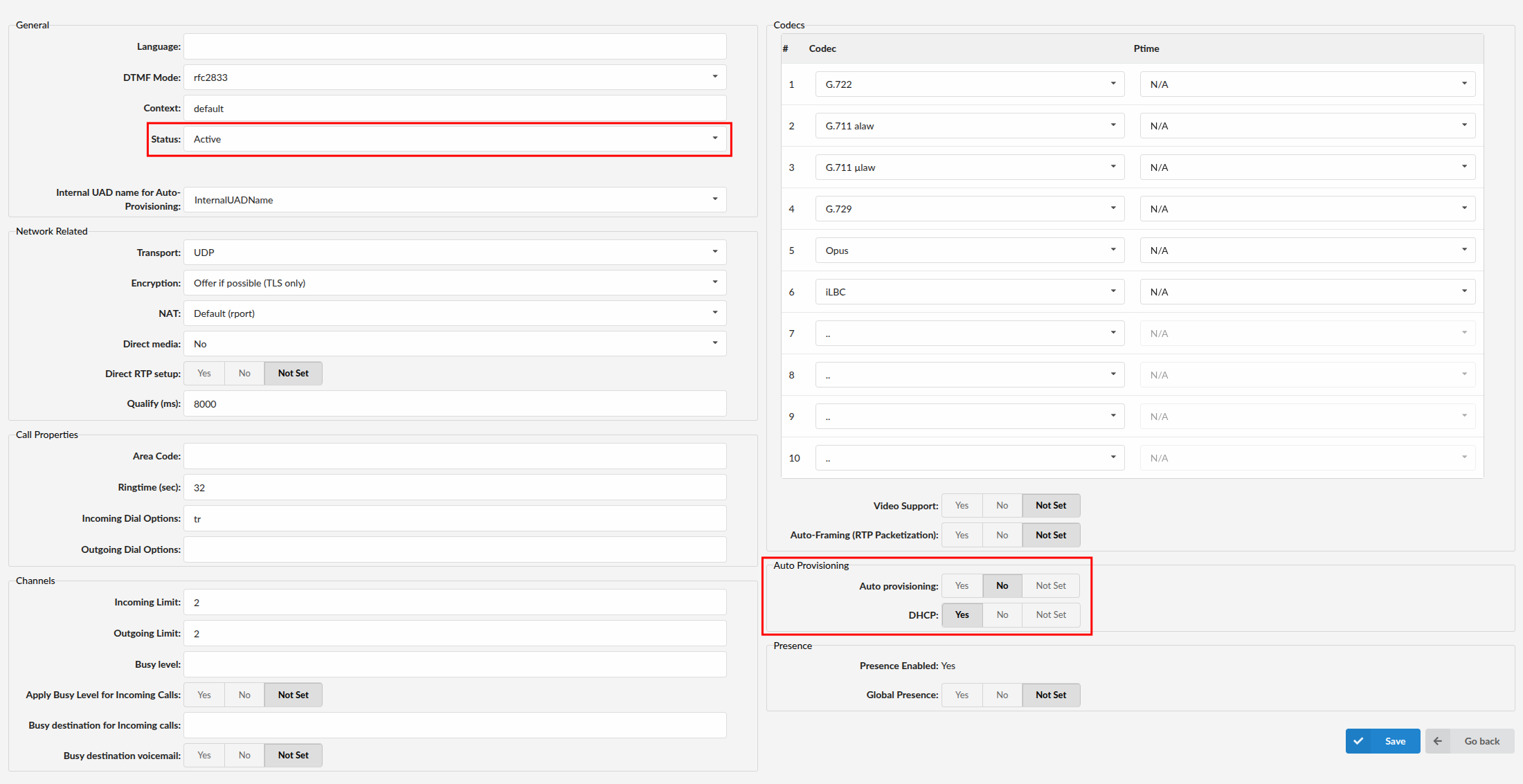
- Ensure that the Yealink T74 LTE UAD is enabled. To check the UAD status, click the Edit icon corresponding to the Yealink T74 LTE phone.
- Verify that Status is set to Active, Auto provisioning is set to No, and DHCP is set to Yes.
- Click the Save button.
¶ Creating an Extension
1. Add Extension
-
Navigate to Extensions, then click Add Extension.
-
The standard options window will open.
-
Select the Yealink T74 LTE phone model from the UAD dropdown menu.
-
Select the Location: Local or Remote.
- Local is for all Extensions registered on the LAN
- Remote is for all Extensions registered from remote networks, WAN, Internet etc.
-
Click the Next step button.
2. Extension Values
Enter values into the required field text boxes.
REQUIRED FIELDS:
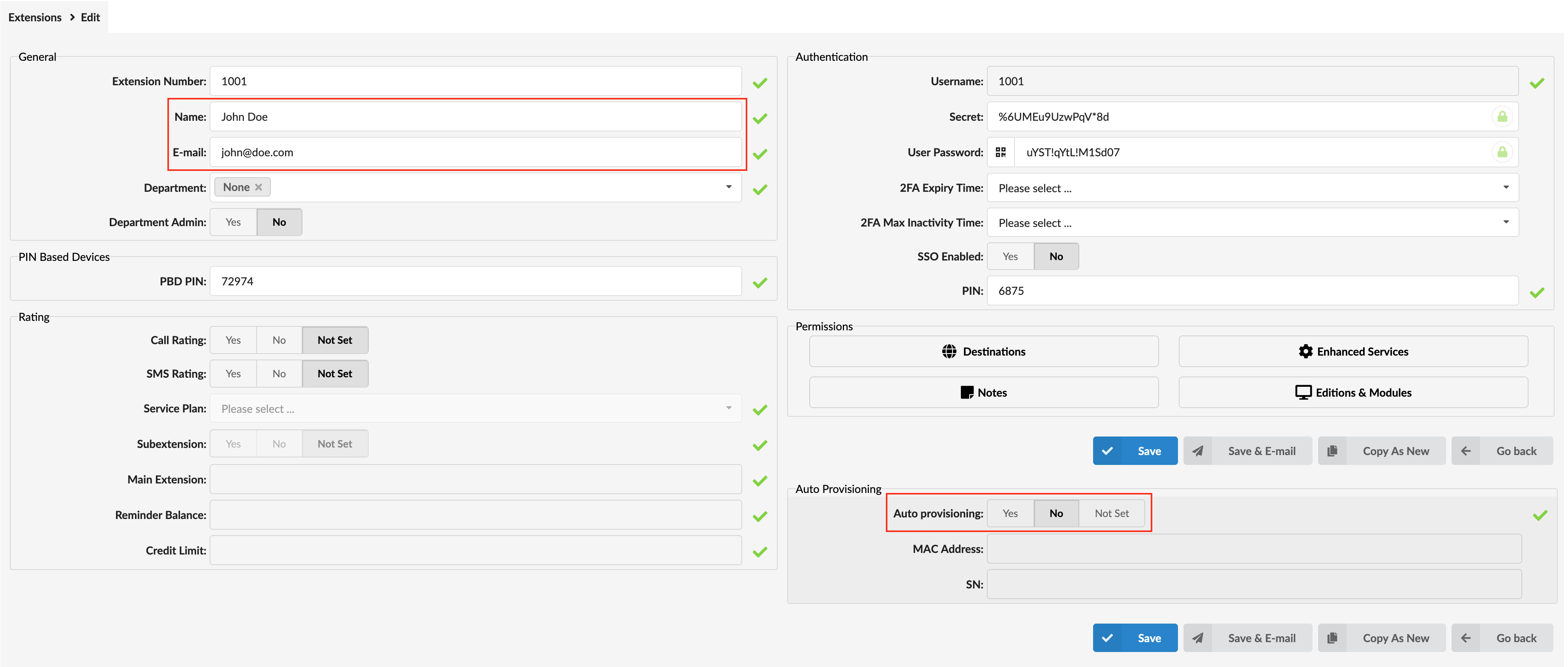
- Name
Enter a name for the extension being created. Example: John Smith.
Enter the e-mail address associated with this extension. This e-mail address will receive all system notification messages. Example: john.smith@bicomsystems.com
- Click the Save button.
¶ Registering the Phone
This section describes how to register the Yealink phone using Hostname or IP Address.
¶ Hostname or IP Address
- Log in to the phone's web administration interface.
- Open a new browser window and enter the phone's IP address in order to access the phone's web administration interface login screen. Example:
http://192.168.1.22 - Click on Account -> Register.
- Enter the following details into the respective fields.
REQUIRED FIELDS:
- Line Active
Make sure the Line Active is set to On.
- Display Name
Enter the PBXware extension name. Example: 1003
- Register Name
Enter the PBXware extension username. Example: 1003
- User Name
Enter the PBXware extension username. Example: 1003
- Password
The Secret of the extension as received in the e-mail associated with this extension. Example: _%Z4M3*Ts9y7. A password is generated automatically for each newly created extension.
- Server Host
Enter the Hostname or IP Address of the PBXware.
- Example for Hostname: voip.bicomsystems.com
- Example for IP Address: 192.168.1.10
- Click the Confirm button.
You'll have to wait for the device to reboot. If everything is done as described above, your phone should be successfully registered with PBXware. Dial *123 to verify registration.
¶ Auto Provisioning
This section describes how to set UAD settings, create a PBXware Extension, and register the phone using DHCP or Static IP address.
The following topics are covered:
- UAD Settings
- Creating an Extension
- Registering the Phone
¶ UAD Settings
1. Log in to PBXware's web administration interface
- Open a new browser window and enter the PBXware IP address to access the administration login screen. Example:
http://192.168.1.10 - Log in to PBXware with your e-mail address and password.
2. UAD settings
- Navigate to Settings > UAD.
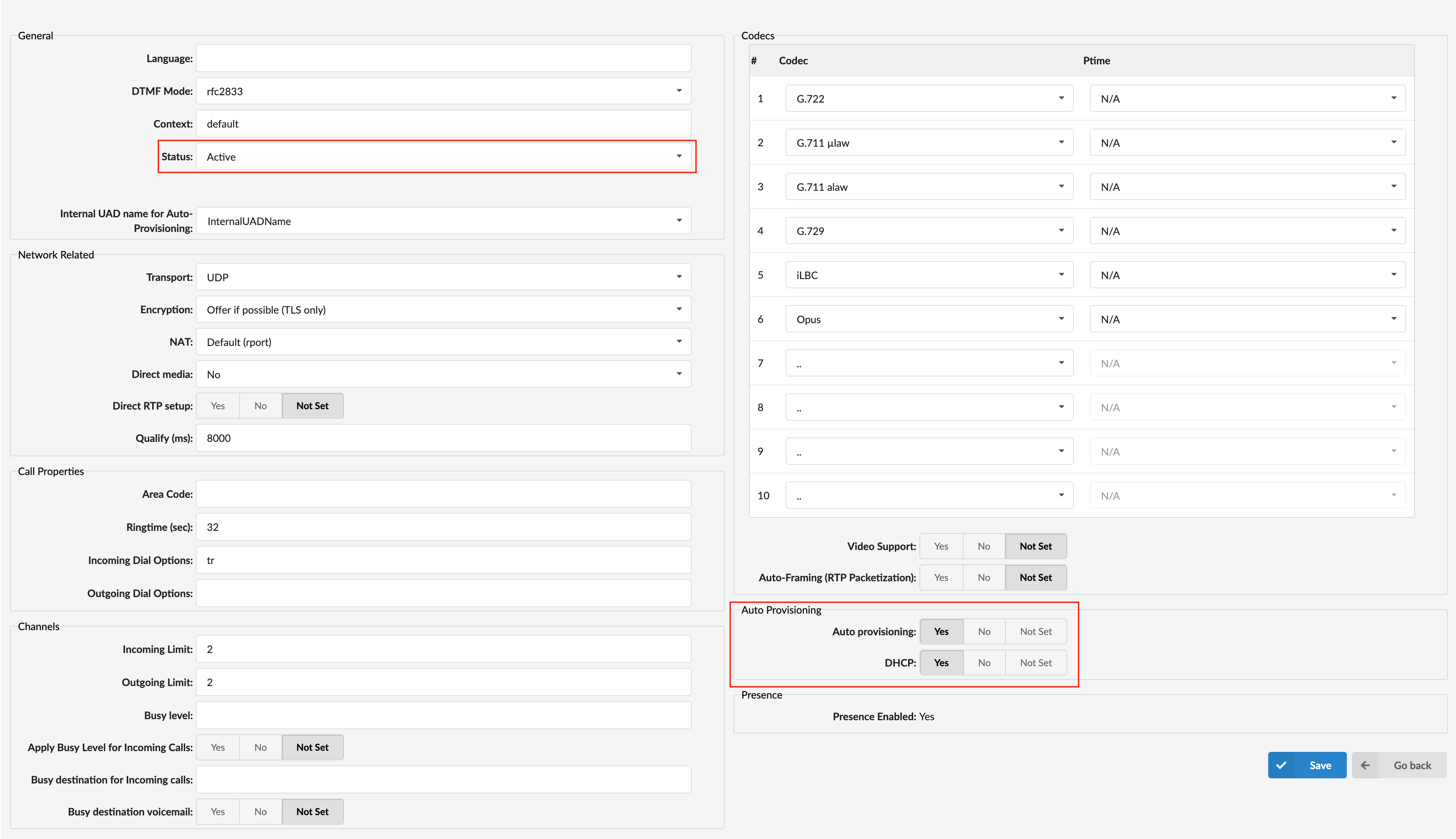
- Ensure that the Yealink T74 LTE UAD is enabled. To check the UAD status, click the Edit icon corresponding to the Yealink T74 LTE phone.
- Verify that Status is set to Active, Auto provisioning is set to Yes, and DHCP is set to Yes.
- Click the Save button.
¶ Creating an Extension
1. Add Extension
-
Navigate to Extensions, then click Add Extension.
-
The standard options window will open.
-
Select the Yealink T74 LTE phone model from the UAD dropdown menu.
-
Select the Location: Local or Remote.
- Local is for all Extensions registered on the LAN
- Remote is for all Extensions registered from remote networks, WAN, Internet etc.
-
Click the Next step button.
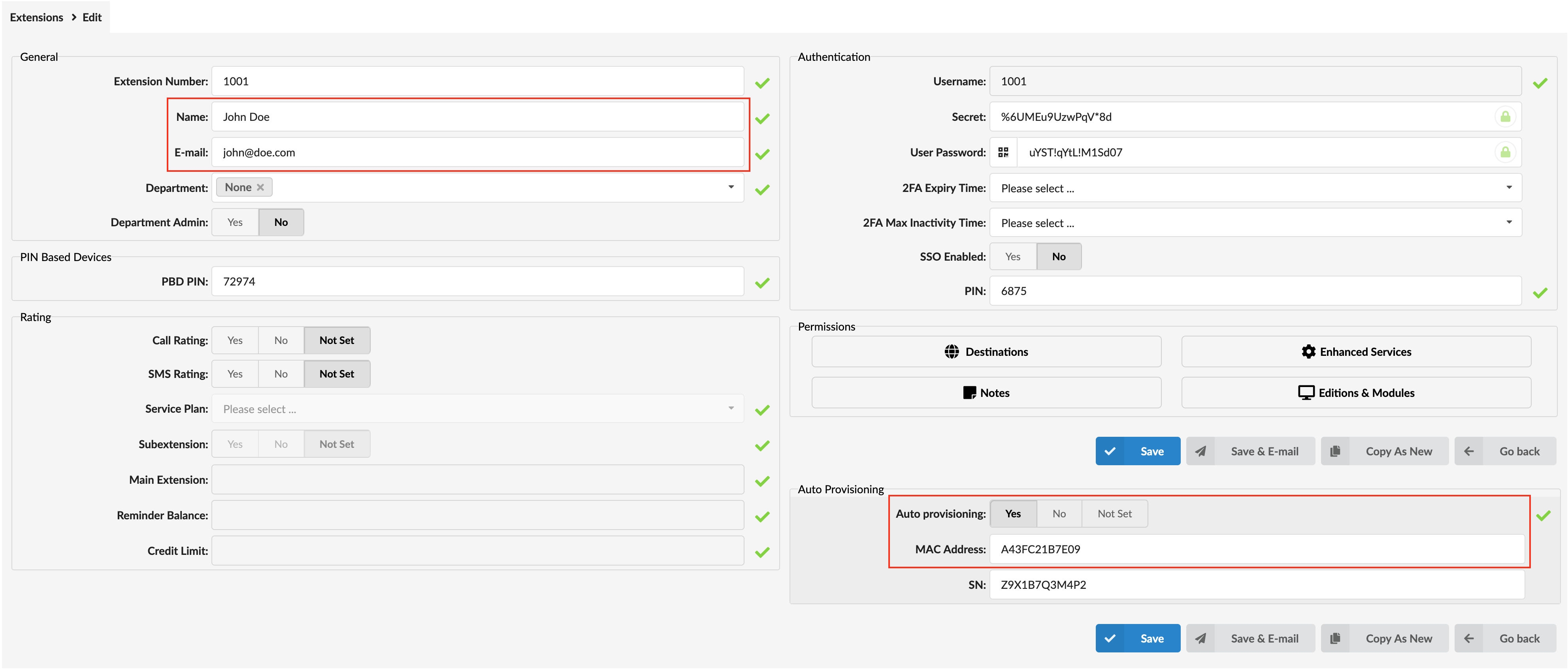
2. Extension Values
Enter values into the required field text boxes.
REQUIRED FIELDS:
- Name
Enter a name for the Extension being created. Example: John Smith.
Enter the e-mail address associated with this extension. This e-mail address will receive all system notification messages. Example: john.smith@bicomsystems.com
- Auto Provisioning
Set to Yes.
- MAC Address
Enter the MAC address of the Yealink phone. Example: 001565FF1536
NOTE: The MAC address can be found on the label at the back of the phone.
- Click Save.
¶ Registering the Phone
This section describes how to register the Yealink phone using TFTP, or HTTP & HTTPS.
¶ TFTP or HTTP & HTTPS
-
Open a new browser window and enter the phone's IP address, e.g.
http://192.168.1.22 -
Click the Settings tab on the left navigation menu and go to the Auto Provisioning.
-
Enter the Auto Provisioning username and password into the Username and Password fields.
-
Choose the server type you intend to use: HTTP, HTTPS or Trivial FTP.
NOTE: Our recommendation is to use HTTP. -
If you decide to use HTTP, enter http:// followed by Hostname or IP Address, then followed by /prov in the Server URL field.
Example of a Hostname using HTTP: http://abc.bicomsystems.com/prov
Example of an IP Address using HTTP: http://192.168.1.10/prov
- If you decide to use HTTPS, enter https:// followed by Hostname or IP Address, then followed by /prov in the Server URL field.
Example of a Hostname using HTTPS: https://abc.bicomsystems.com/prov
Example of an IP Address using HTTPS: https://192.168.1.10/prov
- If you decide to use TFTP, enter tftp:// followed by Hostname or IP Address in the Server URL field.
Example of a Hostname: tftp://voip.bicomsystems.com
Example of an IP Address: tftp://192.168.1.10
- Click the Confirm button.
- Click on Autoprovision Now button.
- Wait for the configuration to update. NOTE: Do not power off your phone during this process.
- The auto-provisioning process will start during the phone's reboot process. The phone will download the appropriate configuration file from PBXware.
- If everything is done as described above, you should have successfully registered your phone to PBXware.
- Dial *123 to verify registration.
¶ Configure BLF
This chapter describes how to configure BLF (Busy Lamp Field) for Yealink T74 LTE.
¶ Extension Settings
1. Log in to the PBXware web administration interface
- Open a new browser window and enter the IP address to access the PBXware web administration login page. Example:
http://192.168.1.10 - Log in to PBXware with your e-mail address and password.
2. Edit the extension
- On the Extensions page click on the Edit icon corresponding to your extension.
- Click the Advanced Options button.
- Scroll down to the Auto Provisioning and Presence settings section.
- Make sure Auto Provisioning is set to Yes.
- Make sure Presence is set to Yes.
- Click the Save button to save the changes.
- Click on Enhanced Services.
- Select the Directory / BLF List checkbox and click the Save button to enable this feature.
- Click the Edit button next to the Directory / BLF List.
- Select the type of DSS key you want to use.
NOTE: For more information about DSS keys, please visit HOWTO DSS KEY page - Enter the Value and Label for DSS key.
- Click the Save button.
¶ Additional Configuration Template
If you want to include additional UAD configuration for Yealink T74 LTE, add fields to the User Agent General Auto Provisioning Template in the Settings -> UAD -> Yealink T74 LTE menu, or add them directly to the extension in the UAD Auto Provisioning Template section.